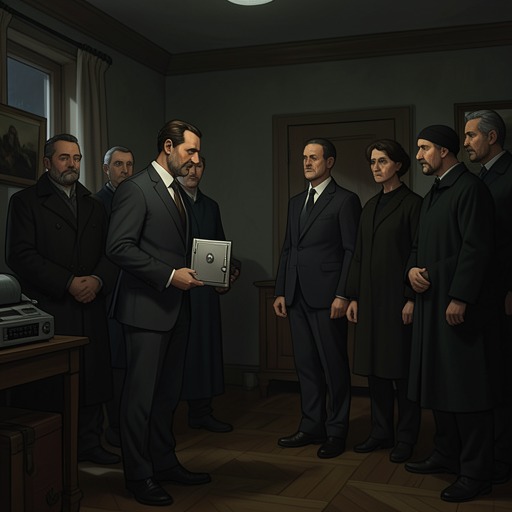
Paul encounters Mrs Tanner in Ankara
The Portable DoorPaul Carpenter’s encounter with Mr Tanner’s mum in Ankara reveals that she is Rosie, a goblin able to pass as a human woman, and that she followed Paul through the portable door. What begins as an unexpected lunchtime meeting becomes a guarded exchange about disguise, attraction, and a suspicious object placed in Paul’s desk. Rosie leaves him with a warning rather than the name of the person responsible: he has entered a world where danger exceeds the limits he learned to expect.
The Meeting in Ankara
Paul recognizes the woman across from him through a family resemblance and begins to identify her as Mr Tanner’s mum before correcting himself to Rosie. The recognition matters because her apparent human form has concealed her identity; for an instant, she appears to him in her goblin shape. She then resumes her chosen appearance, greeting him as someone who knows him already. The brief exposure makes visible the difference between Rosie’s adaptable surface and the identity Paul has just recovered beneath it.
Rosie explains that she is in Ankara for the same reason Paul is: she has stepped out during the lunch hour. She says she followed him through the portable door after he had gone through it, treating the passage as an easy way to join him. The encounter therefore confirms that Paul’s use of the door has not kept his movements private. Rosie can make use of the same route and appear wherever it takes her, turning a device Paul has used for travel into a means by which someone else can follow.
Her arrival also unsettles the ordinary public setting. A passing businessman walks into a lamp-post while looking toward the pair, then gives Paul an angry look. The moment shows that Rosie’s chosen appearance attracts attention and that Paul, seated with her, is drawn into the assumptions other people make about what they see. Her disguise is effective, but it does not make the meeting socially unremarkable.
Disguise, Identity, and Rejection
Rosie speaks openly about being a goblin and treats her human appearance as a form she can choose to maintain or change. She says it does not wash off or disappear at the full moon, and offers to become blonde instead. Paul declines. Her insistence that being a goblin is no reason for him to care, paired with his refusal of the alternative appearance, places the encounter’s tension in his response to her identity and offer, not simply in the disguise itself.
The scene gives Rosie control over how she is seen: she can present a human appearance, briefly show her goblin nature, and choose another look if she wishes. Yet Paul’s recognition interrupts that control. The family resemblance alerts him to who she is, and the momentary goblin form confirms it. Appearance here is neither a reliable guide to identity nor an entirely sealed mask; recognition arrives through a combination of familiarity, disclosure, and the visible change in form.
Rosie also describes goblins as people for whom appearances matter less because they can become anyone or anything. She characterizes her own people as shallow and contrasts their conduct with human ethical standards, while acknowledging that this is not an uncomplicated advantage. Her account makes her both a representative of a group and a particular, self-aware speaker who can discuss its habits without claiming that they are admirable. Paul’s rejection does not resolve their differences; it sharpens the distance between her confidence in transformation and his unwillingness to accept the invitation.
The Unidentified Object and the Warning
The conversation shifts from Rosie’s appearance to an object Paul has found in his desk drawer. She insists that neither she nor Dennis Tanner put it there, and that it did not arrive by itself. When Paul asks whether she knows who did, Rosie says she saw the person do it. She does not give Paul the name, explaining that she is not allowed to tell him. The disclosure narrows the possibilities without solving the mystery: the placement was deliberate, Rosie has direct knowledge, and that knowledge is being withheld under a constraint she does not explain.
Rosie cautions Paul to be careful because he has become involved with unusual people unlike those he grew up among. She distinguishes the danger of his human world from what goblins may do, arguing that even the worst human actions seem mild by comparison. The warning remains deliberately broad: she does not identify the people she means or describe the other dangers. Her refusal to name the person behind the object and her warning about the wider situation leave Paul with information enough to be wary, but not enough to act on a clearly identified threat.
The encounter ends with this imbalance intact. Rosie has shown Paul that she can follow him through the portable door, has made her identity and chosen appearance explicit, and has confirmed that the object in his desk was placed there by someone she witnessed. But she withholds the decisive name. The episode’s significance lies in that combination of revelation and limit: Paul learns that the apparent coincidence has an agent, while the person who could identify that agent leaves him to reckon with the danger without a complete explanation.